The Quantum Roar: How Narasimha Broke the Code
An analytical reading of the Narasimha myth as a critique of rigid binaries. The systems built on exhaustive conditions and neat categories are fragile.
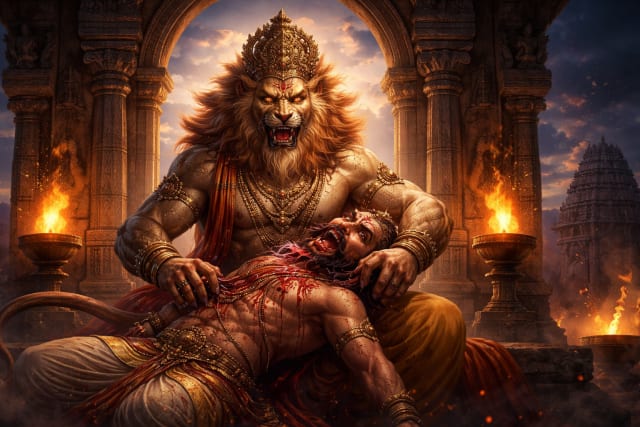
Power often expresses itself through fine print. In the myth of Hiranyakashipu, the demon king does not simply desire immortality. He attempts to engineer it. He secures a series of conditional protections. He cannot be killed by man or beast, neither indoors nor outdoors, neither during the day nor at night, and not by any weapon. Clause by clause, he seeks to eliminate uncertainty. His assumption is straightforward. If language is sufficiently precise, reality will be compelled to obey it. The myth thus begins with a familiar human ambition, the belief that control can be achieved by naming every possibility.
This ambition reflects an enduring fantasy of total design. Draft enough conditions and the future becomes predictable. Seal every exit and risk disappears. Hiranyakashipu treats existence as though it were a legal contract. If every category is specified, nothing remains unspecified. Yet the narrative introduces an anomaly. At twilight, on a threshold between inside and outside, Narasimha appears. He is half man and half lion. He kills the king not during the day or night, not indoors or outdoors, and not with a conventional weapon but with his claws. The conditions are not violated. They are circumvented. The king had prepared for extremes but failed to imagine the interval.
The episode suggests that systems collapse not because their boundaries are weak but because their assumptions are flawed. Hiranyakashipu assumes that reality conforms to binary categories. Man or beast. Light or dark. Safe or vulnerable. By relying on rigid oppositions, he believes he has exhausted all possibilities. Yet reality resists such neat classification. Physics shows that matter behaves as both wave and particle. Biology demonstrates that species evolve gradually and blur distinct divisions. Identity itself shifts across contexts. Across domains, the world appears to privilege thresholds over fixed distinctions. The myth therefore dramatizes a broader cognitive error, the tendency to mistake conceptual clarity for ontological completeness.
One might argue that such an interpretation reads modern concerns into an ancient narrative. Perhaps the story functions solely as theological affirmation of divine supremacy. However, myths endure not only as religious declarations but as models of reasoning. They preserve warnings about patterns of thought. The warning embedded here is that certainty derived from rigid dichotomies is inherently fragile. The spatial and temporal details of the episode reinforce this claim. The killing occurs in a doorway at twilight, with the king placed on a lap suspended between earth and sky. Each element destabilizes oppositional thinking. Narasimha does not break the contract. He exposes its incompleteness.
The relevance of this insight extends beyond mythology. Human beings continue to construct elaborate safeguards in finance, governance, and personal life. These mechanisms aim to minimize uncertainty. Yet disruption often emerges from hybrid forms and unexpected combinations. Transformative change rarely arrives from clearly defined categories. It arises from their intersections. The roar in the narrative is therefore not merely an act of violence. It symbolizes the collapse of false binaries. Whenever we assume that we have accounted for every possibility, we may simply have revealed the limits of our imagination. Power may trust categories, but reality appears to favor thresholds.
Discussion
Sign in to join the discussion.
More in Religion & Mythology
The Archer Nobody Can See
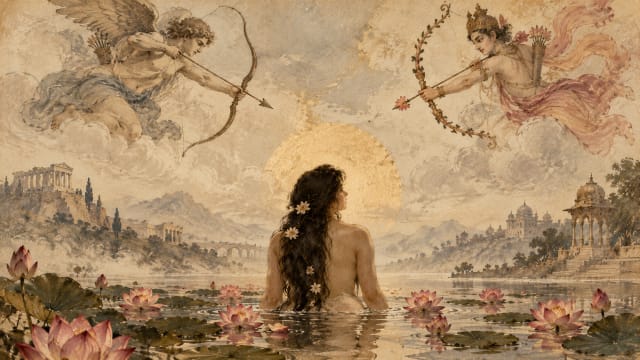
Eros began as a force older than the gods, Kamadeva as the first seed of mind. Somewhere along the way both became boys with bows, and nobody has explained why the wound still feels like it comes from outside.
Why We Only Tell Icarus's Story: An RC Inspired by IIM Indore
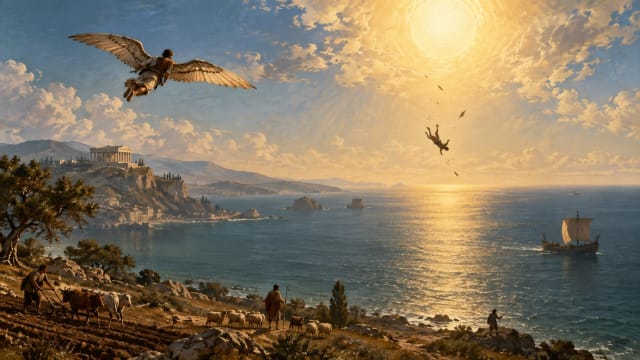
Daedalus built the wings, warned his son, watched him fall, and flew safely to Sicily. He succeeded at everything Icarus failed at. The myth does not remember him.
The God of Obstacles: An RC Inspired by IIM Indore
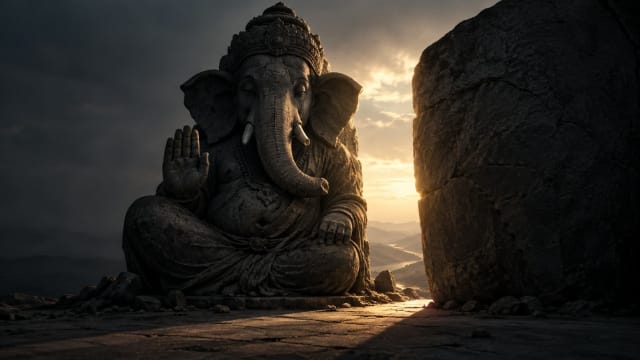
Ganesha removes obstacles. Ganesha places them. The same deity, the same tradition, the same prayer. This is not a contradiction. It may be the most honest theology ever written about the nature of difficulty.
The Strangest Mother in Indian Mythology
Putana came to kill Krishna with poisoned milk. He killed her instead. Then he gave her the status of a mother. The Mahabharata is not confused about this. It is making its hardest argument.