Aporia
The ancient Greeks called it aporia — a lack of passage. It is not the moment when thinking fails. It is the moment when thinking discovers that the question itself was badly formed.
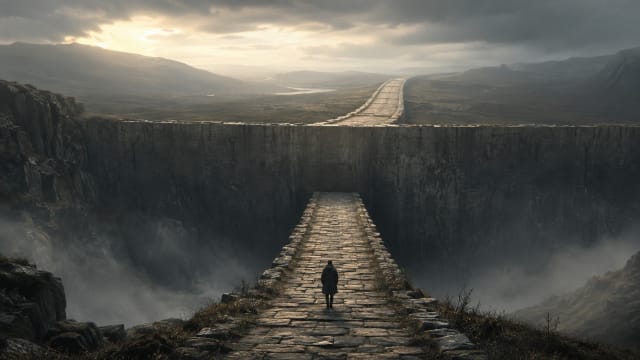
There is a peculiar moment in an argument when the floor seems to disappear. You have followed the reasoning carefully. Each step appeared secure. Yet the conclusion refuses to settle. Worse, the opposite conclusion seems equally defensible. We usually call this confusion, contradiction or ignorance. The ancient Greeks had a more precise word for it. Aporia means a lack of passage. It describes the moment when thought finds no road forward.
At first glance, aporia looks like intellectual failure. If reasoning is supposed to carry us from premises to conclusions, then reaching an impasse suggests that something has gone wrong. Perhaps an assumption was false. Perhaps a distinction was overlooked. Perhaps we simply lack sufficient information. Much of intellectual progress does consist of dissolving such difficulties. Better evidence can eliminate an apparent contradiction. Better concepts can reveal that two opposing claims were never genuinely opposed.
Yet this account misses something important. An aporia does not merely tell us that we lack an answer. It can reveal that the machinery with which we formulate the question is inadequate.
Consider the paradoxes of Zeno. Motion seems among the least controversial facts of experience. A runner crosses a field. A stone falls. A ship moves across water. Yet Zeno could construct arguments suggesting that motion was impossible. To dismiss him as absurd would have been easy. To understand why his reasoning seemed compelling was harder. The eventual development of calculus did not merely answer Zeno. It changed the mathematical language in which the problem could be understood.
Philosophy repeatedly encounters the same phenomenon. Kant argued that reason can generate apparently rational arguments for contradictory conclusions when it attempts to think beyond possible experience. The problem is not simply that one side is foolish and the other intelligent. Rather, reason itself can reach an impasse when it applies its concepts beyond the conditions under which those concepts properly function.
Science offers a similar kind of discomfort. Nature has repeatedly resisted our intuitions. What seems solid is composed of particles. What appears continuous can be quantised. What seems independent can become entangled. Such discoveries do not necessarily show that reality is contradictory. They show that the categories supplied by ordinary experience are not guaranteed to describe what lies beneath it.
One might object that this romanticises confusion. Science advances precisely by escaping aporia. A paradox is useful only until someone finds the missing distinction, experiment or equation. There is little virtue in remaining indefinitely puzzled.
True. Aporia should not become an excuse for intellectual laziness. The point of an impasse is not to remain there. It is to notice that the road itself may have been badly drawn.
Ignorance lacks an answer. Aporia destabilises the question.
This is why Socratic ignorance is more demanding than ordinary ignorance. To say that you do not know is merely to acknowledge an absence of knowledge. To encounter aporia is to discover that what you thought you knew cannot yet be arranged into a coherent whole. Ignorance lacks an answer. Aporia destabilises the question.
Perhaps that is why genuine intellectual revolutions often begin in moments of embarrassment. Someone discovers that the familiar explanation cannot explain everything. The contradiction becomes productive. It forces a distinction. It demands a new concept. It changes a method. What looked like the end of thought becomes the beginning of a different kind of thinking.
We tend to measure intelligence by the speed with which someone reaches an answer. Aporia proposes a stranger measure. It asks whether we can recognise when an answer has arrived too easily.
The deepest thinkers may not be those who always know which road to take. They may be those who occasionally stop and look at the road beneath their feet. They realise that the real problem was never finding the way forward. It was discovering that they had been walking in the wrong direction.
Discussion · 1
passage talks about Greek word aporia which means the moments when thought find no clarity. it shows that we lack answer reflecting ignorance, but it reveals the assumption, framework or concepts behind the question are inadequate. Moments of intellectual impasse should not let the thinker remain confused but to notice the inadequacy of framework, such moments of impasse help thinkers to generate new concepts, framework or assumptions
Sign in to join the discussion.
More in Epistemology

How Doubt Became a Method: An RC Inspired by IIM Indore
Skepticism is not the rejection of knowledge, but a discipline for deciding how much confidence our evidence deserves.
The World's Most Famous Teapot
Discover how Bertrand Russell's famous celestial teapot transformed our understanding of evidence, belief and the burden of proof.

Why Darwin Needed Jane Austen
What Charles Darwin's love for Jane Austen reveals about beauty, evolution, art, and the natural world.

The Measured Face and the Unmeasured Soul
Beauty feels instinctive yet follows patterns of symmetry and proportion shaped by biology and culture. Its deepest impact lies beyond what numbers can capture.