Why Darwin Needed Jane Austen
What Charles Darwin's love for Jane Austen reveals about beauty, evolution, art, and the natural world.
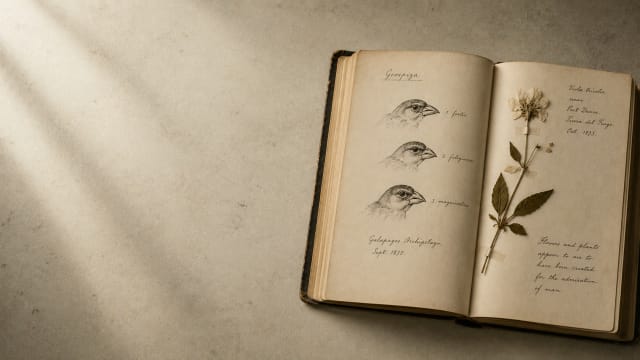
In 1833, somewhere on the restless waters of the South Atlantic, Charles Darwin wrote home with an urgent request. He did not ask for money, though he had little. He did not ask for comfort, though he lived in cramped quarters aboard the HMS Beagle. He asked for books. More specifically, he asked for novels, among them the works of Jane Austen. To Darwin, books were "those most valuable of all valuable things."
At first glance, the pairing seems improbable. Darwin was the architect of evolutionary theory. Austen was the novelist of drawing rooms and marriage markets. One searched for laws governing life itself. The other chronicled the social choreography of provincial England. One studied finches and fossils. The other studied pride and prejudice. Yet Darwin's fascination with Austen reveals a deeper connection between science and art than modern culture often assumes.
Both were obsessive observers. Their genius lay not merely in noticing details but in recognizing that details matter.
Austen examined the smallest gestures. A raised eyebrow, a careless remark, or a muddy petticoat could reveal an entire moral universe. Darwin scrutinized barnacles, finches, orchids, and earthworms in much the same way. A small observation could illuminate a larger truth.This shared attentiveness placed them within a broader intellectual tradition. Europe had become increasingly preoccupied with explaining the natural world. Observation and classification were transforming knowledge. Austen's fiction participated in this culture of inquiry. Her novels often resemble field studies of human behavior. They are populated by recurring patterns of vanity, desire, status, and self-deception. Yet the deepest overlap between Austen and Darwin concerns a philosophical puzzle. Both struggled to understand the place of beauty in the world.
Beauty seemed to resist the logic of utility.
Darwin encountered this puzzle while developing his theory of evolution. Natural selection explained why useful traits survived. Stronger muscles, sharper eyesight, and better camouflage all enhanced survival. Beauty was harder to explain. Why should a peacock carry an extravagant tail that hinders movement and attracts predators? Why should nature produce ornament that appears costly and unnecessary?
Austen wrestled with the same tension from another direction. Her novels repeatedly stage encounters between refinement and nature. In one memorable scene from Pride and Prejudice, Elizabeth Bennet arrives after walking through muddy fields. Her elegance is stained by the natural world. The moment appears trivial, yet it raises a profound question. Is beauty something that elevates us above nature, or is it itself a natural phenomenon?
Many thinkers have treated science and art as opposing domains. Science explains mechanisms. Art explores meaning. Science dissects. Art enchants. From this perspective, Darwin and Austen appear to stand on opposite sides of an intellectual divide.
The evidence suggests otherwise.Darwin eventually argued that beauty possesses evolutionary significance. Ornament, courtship, and aesthetic preference are woven into the fabric of life. Austen portrayed beauty not as a supernatural ideal but as something inseparable from ordinary human existence. Both dissolved the boundary between nature and aesthetics.
The surprising lesson is that beauty may not be an exception to nature's rules. It may be one of nature's deepest expressions. The peacock's tail and Elizabeth Bennet's muddy petticoat belong to the same story.
The naturalist sought to understand why beauty exists. The novelist sought to understand what beauty means.
Perhaps this is why Darwin carried Austen across oceans. He recognized, even if only intuitively, that science and art were confronting the same mystery from different directions. Together, they reveal that the world is not divided between facts and feelings, nature and culture, utility and ornament. Beauty occupies the strange territory where these distinctions begin to dissolve.
Discussion
Sign in to join the discussion.
More in Epistemology

Aporia
The ancient Greeks called it aporia — a lack of passage. It is not the moment when thinking fails. It is the moment when thinking discovers that the question itself was badly formed.

How Doubt Became a Method: An RC Inspired by IIM Indore
Skepticism is not the rejection of knowledge, but a discipline for deciding how much confidence our evidence deserves.
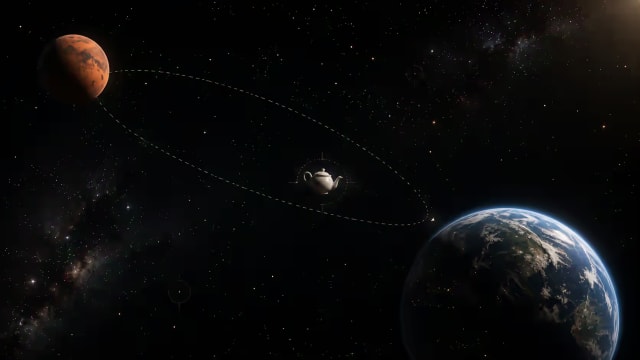
The World's Most Famous Teapot
Discover how Bertrand Russell's famous celestial teapot transformed our understanding of evidence, belief and the burden of proof.
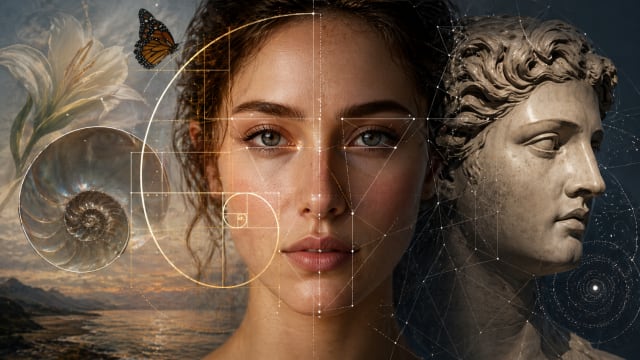
The Measured Face and the Unmeasured Soul
Beauty feels instinctive yet follows patterns of symmetry and proportion shaped by biology and culture. Its deepest impact lies beyond what numbers can capture.