The World's Most Famous Teapot
Discover how Bertrand Russell's famous celestial teapot transformed our understanding of evidence, belief and the burden of proof.
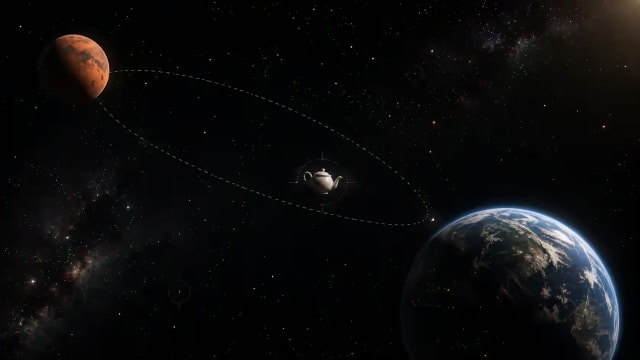
Somewhere between Earth and Mars floats the most influential teapot in history. No telescope has ever found it. No spacecraft has ever photographed it. It almost certainly does not exist. Yet for more than seven decades, this imaginary object has quietly shaped debates about science, religion, philosophy and reason. The world's most famous teapot has never occupied space. Instead, it has occupied the human mind.
In 1952, the British philosopher Bertrand Russell introduced the image in an article responding to a common line of reasoning. Imagine, he wrote, that someone claimed a tiny china teapot orbited the Sun between Earth and Mars. It was so small that no telescope could ever detect it. Since nobody could prove the teapot did not exist, would everyone be obliged to believe in it? Russell's answer was straightforward. The inability to disprove a claim is not evidence that the claim is true. The responsibility to provide evidence belongs to the person making the assertion, not to those questioning it.
"The inability to disprove a claim is not evidence that the claim is true. The responsibility to provide evidence belongs to the person making the assertion, not to those questioning it."
Although the analogy is often remembered as an argument against religion, its real significance extends far beyond theology. Russell was defending a rule that underpins every serious attempt to acquire knowledge. Rational inquiry begins not by asking whether something is conceivable, but whether there are good reasons to accept it. Countless things are logically possible. There might be invisible dragons sleeping in abandoned caves, undetectable civilizations beneath the oceans or intelligent beings hidden within dark matter. None of these ideas violates logic. Yet logic alone does not transform imagination into knowledge. Possibility is merely the opening bid. Evidence decides the auction.
Science embodies this principle more rigorously than any other enterprise. A hypothesis earns acceptance not because no one has disproved it, but because repeated observations support it while every serious attempt to falsify it fails. The same burden of proof governs everyday institutions. Courts require prosecutors to establish guilt through evidence rather than forcing defendants to prove innocence. Journalists verify sources before publishing extraordinary allegations. Doctors demand clinical evidence before prescribing new treatments. These practices differ in purpose, yet all rest upon the same intellectual foundation that Russell illustrated with an imaginary teapot.
Critics sometimes object that not every important belief can be verified scientifically. Moral values, artistic beauty and questions about the meaning of life often resist empirical measurement. This objection is persuasive, but it does not undermine Russell's point. Ethical principles and aesthetic judgments are not factual claims about the physical universe. They belong to different categories of human understanding. Russell's argument applies only when someone asserts that something exists or occurred in the observable world. Such claims invite investigation because they describe reality rather than interpret it.
Possibility is merely the opening bid. Evidence decides the auction.
The enduring brilliance of Russell's analogy lies in its simplicity. By choosing something as ordinary as a teapot, he stripped away emotional attachment and exposed a universal flaw in human reasoning. People often mistake the absence of disproof for the presence of proof. Conspiracy theories flourish because they reinterpret every lack of evidence as evidence of concealment. Pseudoscientific remedies survive because critics supposedly cannot prove they never work. Internet rumours multiply because uncertainty itself becomes a substitute for verification. Russell's teapot anticipated this intellectual habit decades before the digital age amplified it.
The lesson is not that skepticism should triumph over belief. It is that belief must earn its place. A civilization that abandoned the burden of proof would soon drown beneath an ocean of unfalsifiable claims, each demanding equal respect simply because it could not be disproved. Russell's celestial teapot therefore remains far more than a whimsical philosophical joke. It is a reminder that truth advances not by protecting every possibility, but by rewarding those possibilities that withstand the discipline of evidence. The most famous teapot in history never brewed a cup of tea. Instead, it taught humanity how knowledge itself is made.
Discussion
Sign in to join the discussion.
More in Epistemology

Aporia
The ancient Greeks called it aporia — a lack of passage. It is not the moment when thinking fails. It is the moment when thinking discovers that the question itself was badly formed.

How Doubt Became a Method: An RC Inspired by IIM Indore
Skepticism is not the rejection of knowledge, but a discipline for deciding how much confidence our evidence deserves.
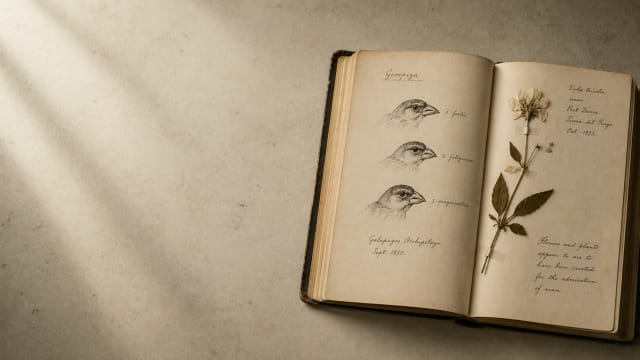
Why Darwin Needed Jane Austen
What Charles Darwin's love for Jane Austen reveals about beauty, evolution, art, and the natural world.

The Measured Face and the Unmeasured Soul
Beauty feels instinctive yet follows patterns of symmetry and proportion shaped by biology and culture. Its deepest impact lies beyond what numbers can capture.