The Measured Face and the Unmeasured Soul
Beauty feels instinctive yet follows patterns of symmetry and proportion shaped by biology and culture. Its deepest impact lies beyond what numbers can capture.
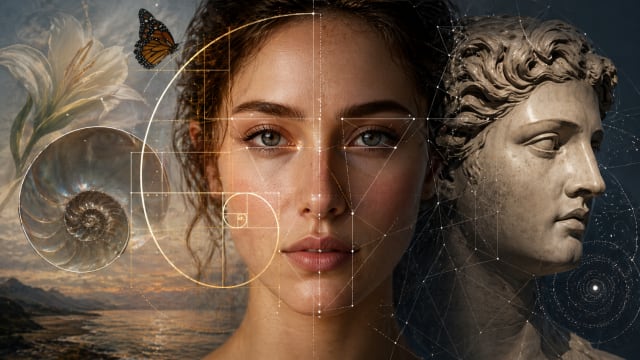
A face appears on a screen and holds us for a moment longer than we expect. We do not announce it, yet something within us begins to count. The eyes align, the features settle into a quiet order, and we call it beautiful. The experience feels immediate, almost sacred. Still, beneath that feeling, a quieter process unfolds, one that resembles measurement more than mystery.
The quantification of beauty begins with a bold claim. What we call beauty often follows structure. Faces judged attractive across cultures tend to share certain proportions. They show symmetry, balance, and a kind of statistical averageness. Researchers argue that such features signal health and genetic stability. Mathematicians notice recurring ratios that echo through art and nature. Even modern algorithms assign scores to faces, often predicting human preference with unsettling accuracy. What feels like intuition begins to look like pattern recognition.
This pattern is not accidental. The human brain evolved to manage complexity by simplifying it. Symmetry is easier to process than irregularity. Balanced proportions create a sense of predictability. In this sense, beauty becomes a cognitive shortcut. It allows the mind to move quickly through a crowded world by favoring what appears orderly and coherent. We do not simply admire beauty. We recognize efficiency and call it pleasing.
Yet something resists this neat conclusion. Perfect symmetry can feel lifeless. A face that matches every ideal ratio can seem cold, even artificial. What draws us in is often a deviation, a small imperfection that suggests movement and story. A slightly uneven smile or an unexpected feature gives a sense of individuality. Beauty, then, is not pure order. It is a tension between order and variation, between pattern and surprise.
Some argue that beauty cannot be reduced to numbers at all. They see it as a product of culture and history, shaped by shifting ideals and social forces. Standards of beauty change across time and place. What one generation celebrates, another rejects. From this view, any attempt to quantify beauty risks oversimplifying a deeply human experience. It mistakes correlation for cause and ignores the role of meaning.
This objection carries weight, yet it does not dismantle the entire argument. Cultural variation does not erase underlying tendencies. It reframes them. Human perception provides a base layer, while culture interprets and amplifies it. Even the most unconventional forms of beauty often rely on contrast, balance, and proportion in some subtle way. The rules bend, but they rarely disappear.
What emerges is a layered understanding. Biology sets the groundwork by shaping how we perceive form. Culture builds upon it by assigning value and significance. Individual experience adds another dimension, coloring perception with memory and emotion. Beauty becomes a negotiation across these levels, not a fixed property but a shifting balance.
The deeper insight lies in the limits of quantification. Numbers can predict attention, but they cannot fully explain attachment. A face may meet every measurable standard and still leave us unmoved. Another may defy those standards and yet linger in the mind long after it is gone. Measurement captures structure, but not presence.
In the end, beauty exists in the space between precision and feeling. We can model it, approximate it, even simulate it. Still, something escapes. That remainder is not a flaw in the system. It is the very reason beauty continues to matter.
Discussion · 2
The measured face and the unmeasured soul * Beauty is instinctive but follows pattern (biology / culturally) * Face which perfect eyes align, good order considered as beautiful but process also unfolds many things * Beauty = structure. (symmetry, balance, state etc) tell us about health and genetic stability. Both maths and modern algo: both tells about human preferences with these scores. * Symmetry is easier to process than irregularity. i.e we don't admire beauty but recognize efficiency and call it pleasing. * Perfect sym is also lifeless, it seems to be artificial a small irregularity leads to individuality. * Beauty = Culture x History. Def of beauty is diff for everyone. By simplifying it we are risking human personal exp. * Cultural variation only reframes. It amplifies human perception. * Conclusion Biology is groundwork- culture amplifies it -individual exp add another dimension. Beauty becomes negotiation not a fixed property. * Mathematics can predict attention but not attachment. We can model it, approximate it even simulate it but still something escapes and that is beauty.
Beauty is not only about looks or perfect features. Science says symmetry and balance make faces attractive, but feelings, culture, and personal experiences also matter. Numbers can explain some patterns, but they cannot explain why we feel connected to someone. In the end, beauty is a mix of biology, emotions, and individual perception.....
Sign in to join the discussion.
More in Epistemology

Aporia
The ancient Greeks called it aporia — a lack of passage. It is not the moment when thinking fails. It is the moment when thinking discovers that the question itself was badly formed.

How Doubt Became a Method: An RC Inspired by IIM Indore
Skepticism is not the rejection of knowledge, but a discipline for deciding how much confidence our evidence deserves.

The World's Most Famous Teapot
Discover how Bertrand Russell's famous celestial teapot transformed our understanding of evidence, belief and the burden of proof.

Why Darwin Needed Jane Austen
What Charles Darwin's love for Jane Austen reveals about beauty, evolution, art, and the natural world.